Skip to content
How Early Do You Need to Wake Up for Angkor Wat Sunrise?
The Real Answer: 3:45 AM (And Why Every Minute Counts)
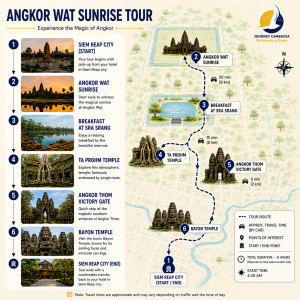
How early do you need to wake up for Angkor Wat sunrise? You’ll need to wake up at 3:45 AM to leave your hotel by 4:15 AM. This gives you time to reach Angkor Wat around 5:00 AM, claim a good viewing spot, and watch the sunrise at approximately 6:00 AM. Tours like the Angkor Wat Sunrise Tour (from $23 per person) handle all logistics, so you just wake up and go. Bottom line: How early do you need to wake up for Angkor Wat sunrise matters less than whether that 3:45 AM alarm delivers the photos and experience you traveled thousands of miles to capture.
You’re going to hate this answer at first. But here’s the truth: you need to wake up at 3:45 AM. Not 4:30 AM. Not “a little before sunrise.” Exactly 3:45 AM.
Why so brutally early?
Because Angkor Wat sunrise isn’t just about watching the sun come up. It’s about claiming your spot before 2,000 other tourists crowd around the reflection pools. It’s about walking through ancient corridors in darkness, flashlight in hand, like an explorer from the 1850s. It’s about being positioned at the library pool edge when the first rays of sunlight turn those five temple towers from gray stone into golden silhouettes reflected perfectly in still water.
Miss that 3:45 AM wake-up? You’ll arrive at 6:15 AM to find the best spots taken. You’ll shoot photos over other people’s heads. You’ll miss the gradual color transformation from deep purple to pink to orange to gold that happens between 5:45 AM and 6:15 AM. And you’ll wonder why your Instagram doesn’t look like the photos that made you book Cambodia in the first place.
Let’s break down what happens hour by hour.
3:45 AM: Your alarm screams. You want to throw it across the room. Don’t. This moment determines whether you get iconic photos or tourist snapshots.
4:15 AM: Your driver pulls up. Most hotels in Siem Reap coordinate with tour operators for this exact pickup window. The streets are empty except for tuk-tuks ferrying other sunrise seekers.
4:45 AM: You arrive at the entrance gate. Rangers check your Angkor pass ($37 for one day, $62 for three days). The temple grounds are dark. Really dark. Stars still visible overhead.
5:15 AM: You reach the library pool viewing area. If you arrived on schedule, you get front-row access. This is where the magic happens.
5:45 AM: The sky starts its transformation. First hints of color appear on the horizon behind the temple towers.
6:00 AM to 6:15 AM: Peak sunrise. The sky erupts in color. Temple towers reflect in the pool. Everyone goes silent. Cameras click. This is the moment you woke up for.
6:30 AM: Crowds thin out. Most tourists leave after sunrise photos. You? You explore the temple interior while it’s still relatively empty and cool.
Tours like the Angkor Wat Sunrise Tour handle every detail of this timeline. Hotel pickup at 4:15 AM. Entrance fees coordinated. Expert guide who knows the eastern entrance route (most tourists don’t). You spend zero mental energy on logistics. Just wake up, board the van, and experience the sunrise that National Geographic calls “one of the world’s most beautiful.”
But what if you’re not a morning person? Read on. There are alternatives.
What Happens If You Sleep In? (Honest Reality Check)
Let’s say you ignore that 3:45 AM alarm. You think “I’ll catch sunrise at 5:30 AM.” Here’s what actually happens.
5:30 AM Arrival: The parking lot is already full. You’re walking to Angkor Wat as the sky brightens. By the time you reach the reflection pool area, the best front-row spots along the left pool are completely packed. You’re stuck behind three rows of tourists holding phones and iPads overhead. Your “sunrise photo” shows the backs of strangers’ heads.
5:45 AM Arrival: Forget the reflection pool. It’s a mob scene. You’ll shoot from way back, temple towers tiny in your frame. The gradual color transformation? You missed it. You arrive when the sky is already pink. The transition from darkness to dawn (the most magical part) happened while you were still in your tuk-tuk.
6:00 AM Arrival: Sunrise is over. You get harsh sunlight and emptying crowds. The soft, golden “magic hour” light that makes Angkor Wat glow? Gone. You’ll spend the rest of your trip looking at other travelers’ sunrise photos thinking “I should have woken up earlier.”
Here’s the thing most travel blogs won’t tell you: Angkor Wat sunrise isn’t flexible. The sun doesn’t negotiate. The crowds don’t disappear. And that 3:45 AM wake-up isn’t a suggestion—it’s the price of admission to one of the world’s most photographed moments.
Angkor Wat sunrise tour price starts around $23 per person for small groups, $45+ for private experiences. That investment includes guides who arrive early enough to claim good positions, who know the eastern entrance shortcut, who handle your entrance ticket coordination. You pay for expertise that turns a 3:45 AM wake-up from painful to seamless.
But maybe you’re thinking: “Can’t I just see sunrise from my hotel and visit Angkor Wat later?” Sure. You’ll save sleep. You’ll also miss the entire point. Angkor Wat sunrise isn’t about convenience. It’s about witnessing light transform ancient stones in ways that photographs can’t fully capture. It’s about standing where Henri Mouhot stood in 1860 when he “rediscovered” these temples for the Western world. It’s about experiencing architecture and nature collaborating on something genuinely transcendent.
Still not convinced about that 3:45 AM alarm? Let me show you what happens when you commit to the early wake-up.
Why That Brutal Wake-Up Time Delivers Photos Everyone Asks About
You know those Angkor Wat photos where the temple towers pierce a pink sky reflected in still water? The ones that look impossibly perfect? Those shots require three things:
- Arriving before crowds
- Positioning at specific reflection pool angles
- Shooting during the 30-minute window when light conditions align
Miss any one element and your photos look like everyone else’s. Nail all three and you capture images that make people ask “How did you get that shot?”
Here’s what separates professional-level sunrise photos from tourist snapshots:
Light Quality: Between 5:45 AM and 6:15 AM, sunlight passes through the atmosphere at an angle that creates soft, golden tones. Photographers call this “magic hour” or “golden hour.” Arrive at 6:30 AM and you get harsh white light that washes out details and creates unflattering shadows. The difference in photo quality is dramatic.
Water Reflections: The reflection pools in front of Angkor Wat create that iconic mirror effect. But here’s the catch: water only reflects perfectly when it’s completely still. Even slight winds create ripples that ruin the reflection. Early morning (5:30 AM to 6:30 AM) offers the calmest conditions. By 7:00 AM, breezes pick up and the mirror effect disappears.
Crowd Control: Tourism to Angkor Archaeological Park topped 2.1 million visitors in 2019 (pre-pandemic numbers). While visitor numbers are lower now, sunrise at Angkor Wat still attracts 1,000+ people daily during high season (November through March). The reflection pool area has maybe 50 prime viewing spots along the edge. First-come, first-served. Arrive at 5:15 AM and you choose your angle. Arrive at 5:45 AM and you’re shooting over shoulders.
Temple Entry Timing: Most visitors don’t realize you can enter Angkor Wat’s inner galleries starting at 7:30 AM. If you arrive for sunrise at 5:00 AM, watch the show until 6:30 AM, you’re positioned to explore the temple interior while it’s relatively empty. Tourists who skip sunrise typically show up around 8:30 AM or 9:00 AM when corridors are packed and temperatures are climbing.
The Angkor 2-Day Sunset and Sunrise Small Group Tour builds this photo advantage into the itinerary. Day one covers sunset at alternative temples (avoiding afternoon heat). Day two hits Angkor Wat sunrise, followed by Ta Prohm (the “Tomb Raider temple”) and Bayon with its 200+ stone faces. You get optimal lighting conditions at every location. Angkor Wat guided tour price for this two-day experience: $46 per person in small groups, with all logistics handled.
But let’s talk about the single biggest reason that 3:45 AM wake-up matters.
The Eastern Entrance Secret That Changes Everything
Here’s insider knowledge that separates informed travelers from tourists following outdated guidebooks.
Most visitors enter Angkor Wat from the western causeway (the main entrance). That’s where tour buses unload masses of visitors who walk the 350-meter stone causeway to reach the temple. During sunrise, this western approach becomes a bottleneck. You’re stuck in slow-moving crowds, missing precious positioning time.
Smart guides (the kind included on tours like the Angkor Wat Sunrise Tour) use the eastern entrance. This back entrance requires arriving in darkness with flashlights, walking through ancient corridors past the world’s longest continuous bas-relief carvings. It feels like exploration rather than tourism. And it positions you at the reflection pool viewing area 10 to 15 minutes faster than the western entrance route.
Why does this matter? Because those 10 to 15 minutes determine whether you get front-row spots or third-row obstructed views. The eastern entrance also delivers atmosphere you won’t experience entering from the main causeway. You’re walking through corridors by flashlight, surrounded by 800-year-old stone carvings emerging from darkness. It’s eerie. It’s magical. It’s exactly how temple explorers experienced Angkor in the 19th century.
But here’s the catch: you can’t just wander into the eastern entrance on your own. You need to know the path. You need to arrive before gates open to general traffic. You need flashlights (not your phone screen). This is where Angkor Wat tour packages with experienced guides justify their cost. You’re not just paying for transportation. You’re buying access to routes and timing that independent travelers miss.
Angkor Wat sunrise tour price variations depend partly on this kind of insider access. Budget tours (under $20 per person) typically use standard western entrance routes with larger groups. Mid-range tours ($23 to $35 per person) include eastern entrance access with smaller groups. Premium private tours ($45 to $65 per person) add flexibility to explore at your pace after sunrise without group scheduling constraints.
Still wondering if that 3:45 AM alarm is worth it? Let’s talk about what happens after sunrise.
The Angkor Wat Sunrise Tour capitalizes on this post-sunrise advantage. After watching sunrise (6:00 AM to 6:30 AM), you spend two full hours exploring Angkor Wat’s interior. Your guide decodes the bas-relief stories (most depict scenes from Hindu epics like the Ramayana and Mahabharata). You access the upper terraces (restricted during crowded midday hours). You learn why Angkor Wat faces west (unusual for Hindu temples, most face east).
NOTE: Angkor Wat day tour cost for this sunrise-to-midday schedule: $23 to $35 per person in small groups, including hotel pickup, air-conditioned transport, expert guide, and visits to four major temples (Angkor Wat, Ta Prohm, Bayon, Angkor Thom). Temple entrance passes ($37 for one day, $62 for three days) are purchased separately at official ticket counters.
But what if you physically can’t wake up at 3:45 AM? Let’s explore alternatives.
Can’t Do 3:45 AM? Here Are Your Actual Options
Not everyone functions at 3:45 AM. Medical conditions. Young children. Night-shift work schedules. Jet lag. Sometimes that early wake-up just isn’t possible.
Here are three alternatives that don’t involve predawn alarms:
Option 1: Sunset at Angkor Wat Instead
Angkor Wat sunset happens around 5:30 PM to 6:00 PM (varies by season). Crowds are smaller than sunrise (most tourists prioritize sunrise). The light quality is nearly as good (though temple orientation means the front facade stays backlit). You wake up at normal hours, explore temples during morning and early afternoon, then position at Angkor Wat for sunset.
Downsides: Afternoon heat is brutal (95°F/35°C is common in hot season from March to May). The reflection pool effect works less reliably (afternoon breezes create ripples). Temple interior exploration happens in harsh midday light.
Angkor Wat sunset tour cost: Similar to sunrise tours ($20 to $35 per person), but afternoon logistics are simpler (no 4:00 AM hotel coordination).
Option 2: Skip Angkor Wat Sunrise Entirely
Focus your early wake-up energy on lesser-known temples that deliver similar photo magic without Angkor Wat crowds. Pre Rup temple (a 10th-century brick structure) offers stunning sunrise views with maybe 20 other tourists present. Srah Srang reservoir provides sunrise reflections without the reflection pool crowds.
The trade-off: You’ll see beautiful sunrises. You won’t see THE Angkor Wat sunrise that appears in every Cambodia guidebook and travel documentary. If that photo-in-front-of-temple-at-sunrise moment matters to you, skipping Angkor Wat sunrise may trigger regret.
Option 3: Angkor Wat at Midday (With Strategic Planning)
Visit Angkor Wat around 11:00 AM to 2:00 PM when crowds peak. Why would anyone choose the worst possible time? Because most tourists are outside taking photos. Inside the temple galleries and corridors, crowds thin out. You’ll share the bas-relief carvings with fewer people than during “ideal” morning hours.
You’ll need to accept brutal heat (bring 3+ liters of water per person), harsh shadows that flatten architectural details in photos, and missing the sunrise/sunset color shows. But if sleeping until 7:00 AM is non-negotiable, midday temple touring is viable.
For travelers committed to sunrise but wanting to avoid Angkor Wat crowds, consider the Angkor 2-Day Sunset and Sunrise Small Group Tour. Day one focuses on sunset at temples outside Angkor Wat (Banteay Srei, Pre Rup, Neak Pean). Day two handles Angkor Wat sunrise. You get two sunrise/sunset experiences, reducing pressure to “get it perfect” at Angkor Wat.
Angkor Wat small group tour price for this two-day option: $46 per person, including transport, guide, and strategic temple sequencing that works around crowd patterns.
Worth It or Overhyped? (Real Talk from Travelers Who Did It)
Time for brutal honesty. Is waking up at 3:45 AM to watch sunrise at Angkor Wat actually worth it?
YES if:
You care about travel photography. Angkor Wat sunrise delivers world-class photo opportunities that don’t exist later in the day. If you’re building a portfolio, documenting your travels, or just want those iconic images, sunrise is non-negotiable.
You appreciate architecture and history. Experiencing Angkor Wat in dawn’s soft light, with minimal crowds, lets you actually absorb the scale and artistry. You’re not fighting for space. You’re not dripping sweat. You can stand in corridors reading bas-relief carvings without tour groups pushing past.
You value unique experiences. How many times in your life will you watch sunrise at a 900-year-old temple? This is bucket-list territory. The early wake-up is uncomfortable for one morning. The memory lasts forever.
NO if:
You’re not a morning person and won’t enjoy it. If you’ll be miserable and resentful at 5:00 AM, that resentment taints the experience. Better to visit Angkor Wat at 9:00 AM fully awake and present than at 6:00 AM half-asleep and grumpy.
You have mobility limitations. The 3:45 AM wake-up, walking in darkness, positioning around reflection pools, climbing steep temple stairs (those worn 12th-century steps are no joke)—it’s physically demanding. If this sounds overwhelming, alternative visit times work better.
You’re traveling with young children. Kids under 8 typically can’t handle the early wake-up, long morning, and temple exploration endurance. Most tour operators don’t permit children under 8 on sunrise tours for good reason.
Weather’s bad. During rainy season (May through October), morning downpours are common. Clouds block sunrise color shows. If weather forecasts predict storms, consider skipping sunrise for a clearer day later in your trip.
The Middle Ground:
You don’t have to choose all-or-nothing. The Angkor 2-Day Sunset and Sunrise Small Group Tour gives you two attempts at golden hour temple photography. Day one focuses on sunset (easier wake-up). Day two tackles Angkor Wat sunrise. If weather or energy levels sabotage one attempt, you’ve got a backup plan.
Angkor Wat tour package price for this two-day approach: $46 per person, which breaks down to $23 per tour day. You’re spreading the early wake-up stress across multiple experiences while increasing your odds of perfect conditions.
-
 Small Group Tours
9:45 AM Pickup – Angkor Thom, Ta Prohm and Sunset in Angkor Wat Golden Hour Tour
$29 Add to cart