 Skip to content
Top 4 Temples for First-Time Visitors to Angkor
Top 4 Temples for First-Time Visitors to Angkor That Save Time and Skip Stress
See the Top Temples for First-Time Visitors with Siem Reap 3 Day Slow Travel – Ta Prohm, Bayon at Angkor Thom, Angkor Wat and Beng Mealea
The Top 4 Temples for First-Time Visitors to Angkor are Ta Prohm (jungle temple with massive tree roots), Bayon at Angkor Thom (216 smiling stone faces), Angkor Wat (world’s largest religious monument), and Beng Mealea (unrestored adventure temple). These four give you everything Angkor offers without the exhausting rush through dozens of similar-looking ruins. The Top Temples for First-Time Visitors with Siem Reap 3 Day Slow Travel program visits all four at optimal times with golden hour lighting, minimal crowds, and rest breaks built in. You’ll get the iconic shots, understand the history, and leave wanting more instead of needing recovery time. Skip the 47-temple marathon and see these four properly.
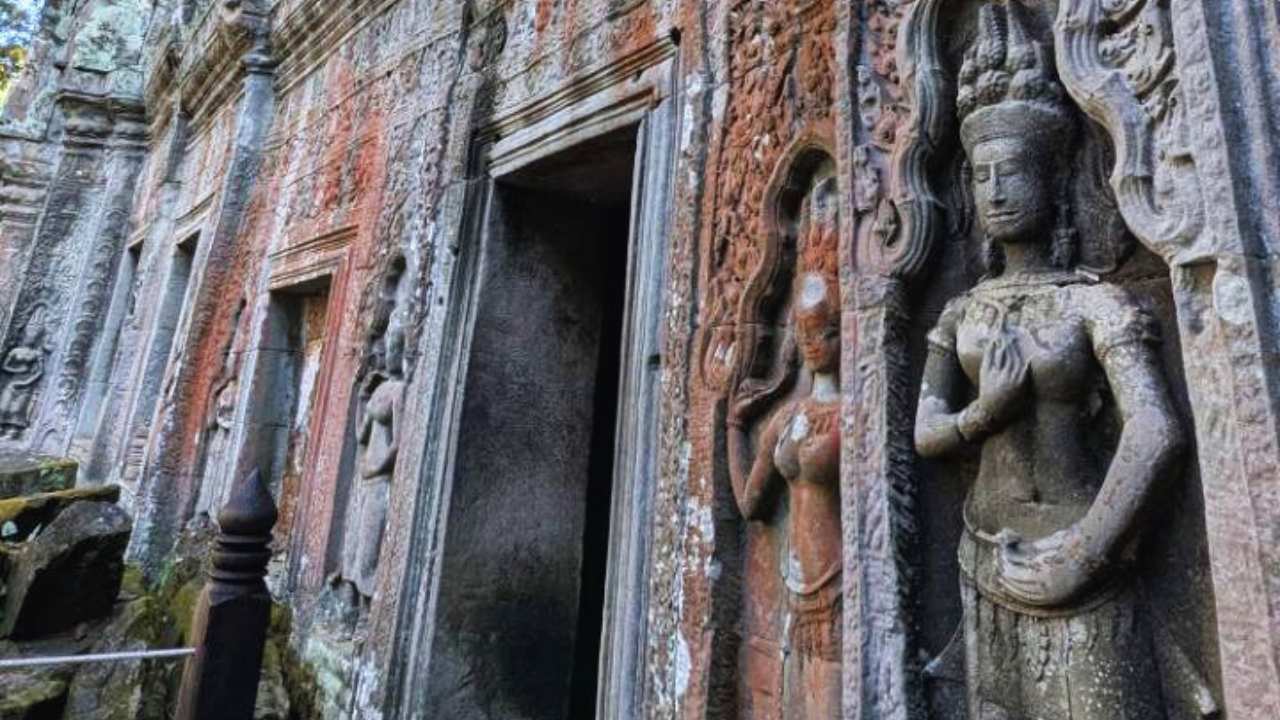
Your Complete Guide to Angkor’s Must-See Temples with Siem Reap 3 Day Slow Travel
A visit to the Top 4 Temples for First-Time Visitors to Angkor gives you the complete Angkor experience without temple fatigue. These four temples represent different architectural styles, time periods, and states of restoration, covering Ta Prohm’s nature-reclaimed galleries, Bayon’s massive stone faces at Angkor Thom, Angkor Wat’s preserved grandeur, and Beng Mealea’s jungle adventure atmosphere.
Key Features of Top 4 Temples for First-Time Visitors to Angkor:
- Ta Prohm Temple – Massive strangler fig and silk-cotton trees bursting through 12th-century galleries, creating that iconic jungle temple atmosphere made famous by Tomb Raider filming
- Bayon Temple at Angkor Thom – 216 serene smiling faces carved in stone towers, representing either Buddha or King Jayavarman VII depending on which scholar you ask
- Angkor Wat Main Temple – World’s largest religious monument spanning 162 hectares with three levels of galleries covered in bas-relief carvings showing Hindu mythology and historical battles
- Beng Mealea Jungle Temple – Largely unrestored 12th-century temple overtaken by forest, offering adventure-style exploration with wooden walkways winding through collapsed stones
- Golden hour photography opportunities – Morning light at Ta Prohm and afternoon light at Angkor Wat create perfect conditions for photos without harsh shadows
- Varying crowd levels – Strategic timing visits Ta Prohm at 6 AM before tour buses and Beng Mealea’s remote location means fewer tourists overall
- Cultural context provided – Licensed guides explain Hindu cosmology, Buddhist transitions, Khmer empire history, and modern conservation efforts at each site
- Physical activity range – From easy walking at Ta Prohm to steep stairs at Angkor Wat to scrambling over stones at Beng Mealea
Tour Options Available:
- Individual temple day trips – Single temples visited in half-day tours, good for short stays or specific interests
- Two-day temple circuit tours – Traditional approach visiting multiple temples per day, more rushed but covers more ground
- Three-day slow travel itinerary – Balanced approach with rest periods, optimal timing, and all four temples without exhaustion (Siem Reap 3 Day Slow Travel)
- Jungle temple specialty tours – Focus on Beng Mealea and remote sites like Koh Ker for adventure seekers (Koh Ker and Beng Mealea Jungle Explorer)
- Photography-focused tours – Timing built around best light conditions for each temple
What to Expect:
- Starting point – All tours pickup from Siem Reap city hotels with 15-60 minute drives to temple sites
- Physical requirements – Moderate fitness needed for temple stairs (especially Angkor Wat’s steep central tower), uneven surfaces, and tropical heat
- Duration – Individual temples take 1.5-3 hours each; complete four-temple coverage needs 2-3 days minimum
- Entrance requirements – Angkor 3-day pass ($62) covers Ta Prohm, Bayon, and Angkor Wat; Beng Mealea requires separate $10 fee
- Dress code – Shoulders and knees covered at all temple sites (strictly enforced)
- Best timing – November through March offers comfortable temperatures; rainy season (June-October) creates dramatic atmosphere but afternoon storms
Things to Consider:
- Budget factors – Temple pass costs, guide fees ($25-40 per day), transportation, and meals add up quickly
- Time available – Rushed one-day visits leave you exhausted; three days allows proper pacing
- Personal interests – Photography enthusiasts need golden hour timing; history buffs need good guides; adventure seekers prioritize Beng Mealea
- Physical limitations – Angkor Wat’s stairs are steep; Beng Mealea requires scrambling; heat affects everyone
- Crowd tolerance – Morning Angkor Wat sees massive sunrise crowds; afternoon visits are calmer
Other Options Include:
- Banteay Srei – Intricate pink sandstone carvings, smaller scale, 30km from Siem Reap
- Preah Khan – Sprawling monastic complex with atmospheric tree roots
- Ta Som – Smaller temple with iconic tree-covered gate tower
- Phnom Bakheng – Sunset views over Angkor Wat (very crowded)
Remember That:
- Angkor 3-day pass costs $62 per person, valid for 10 days from first use
- Sunrise tours require 3:30-4:00 AM wake-ups which many first-timers regret
- Midday heat reaches 35-38°C making afternoon temple visits brutal without rest breaks
- Licensed guides cost extra but transform stone piles into understandable history
- Photography works best during golden hours (6-8 AM and 4-6 PM)
- Beng Mealea sits 54km from Siem Reap requiring 1.5 hour drive each way
- Most tourists skip Beng Mealea making it the least crowded of the four
The Top 4 Temples for First-Time Visitors to Angkor cover every style the ancient Khmer empire built – jungle ruins, Buddhist statuary, Hindu cosmology, and raw archaeological adventure. See these and you’ll understand why Angkor changed world architecture.
Why These Four Temples? (And Why Not 40?)
Look, Angkor Archaeological Park covers 400 square kilometers. Over 1,000 temples sit in that area. Some guidebooks try convincing you to see 47 temples in three days.
That’s insane.
After temple number eight, they all blur together. You’ll forget which one had the naga serpent balustrades and which one had the library buildings. Your photo roll becomes an undifferentiated mass of stone ruins.
The Top 4 Temples for First-Time Visitors to Angkor were chosen because each offers something completely different. Ta Prohm shows nature reclaiming human architecture. Bayon represents Buddhist transition with those haunting stone faces. Angkor Wat demonstrates Hindu cosmology at monumental scale. Beng Mealea gives you adventure-style archaeology.
See these four properly and you’ll understand Angkor. Rush through twenty temples and you’ll understand nothing except what heat exhaustion feels like.
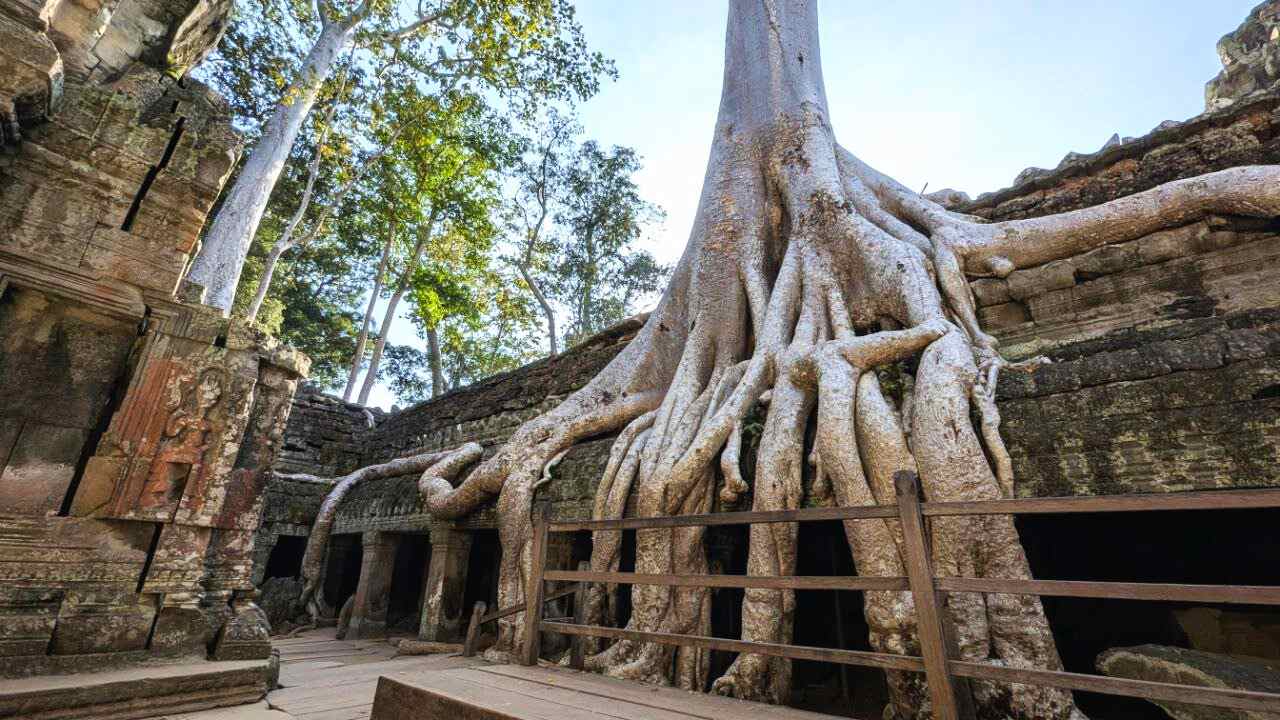
1. Ta Prohm Temple – Where Nature Wins
The Jungle Temple Everyone Photographs
Ta Prohm looks like nature photography and ancient architecture had a baby. Massive strangler fig trees burst through galleries. Silk-cotton tree roots flow over walls like frozen water. Stones and trees hold each other up in impossible balance.
Built in 1186 by King Jayavarman VII as a Buddhist monastery and university, Ta Prohm housed 2,740 monks at its peak. After the Khmer empire collapsed, jungle reclaimed the complex for centuries.
Why Ta Prohm Makes the Top 4 Temples for First-Time Visitors to Angkor:
Modern restoration preserves the atmospheric decay instead of rebuilding everything. The Archaeological Survey of India works to stabilize structures while keeping that “lost temple” feeling intact. You get to see what early explorers found when they “discovered” Angkor in the 1860s.
The trees do impossible things here. Some roots are thicker than your torso. They crack through stones, wrap around doorways, and somehow support crumbling galleries they’re simultaneously destroying. Botanists still debate whether the trees cause more damage or actually hold structures together.
Tomb Raider filmed here in 2000. That scene where Angelina Jolie walks through the temple? You’ll recognize it immediately. But the real temple beats any movie version because you’re standing there, smelling the moss, feeling the humidity, watching actual conservation work happen.
Best time to visit: Early morning (6:00-8:00 AM) before tour buses arrive. The light filters through tree canopy creating that golden glow photographers obsess over. Temperature is comfortable. You can hear birds instead of crowds.
What you’ll see:
- Spung trees (silk-cotton/kapok) with gray bark and plate-like roots
- Strangler figs with aerial roots that look like melted wax
- The “Tomb Raider” doorway (everyone photographs this, embrace the cliché)
- Collapsed galleries where stones fell in artistic piles
- Working conservation areas where you can watch restoration techniques
- Apsara carvings still visible on walls not covered by trees
Physical requirements: Mostly flat walking on established paths. Some stones to step over. Uneven surfaces throughout. Takes about 2 hours to see properly.
Insider tip: After seeing the main temple, walk to the small structures on the northern edge. Almost nobody goes there. Same tree-covered ruins, zero crowds.
| Feature | Details |
|---|---|
| Built | 1186 CE under Jayavarman VII |
| Original purpose | Buddhist monastery and university |
| Notable trees | Strangler figs (Ficus strangulosa), Silk-cotton trees (Tetrameles nudiflora) |
| Film location | Lara Croft: Tomb Raider (2000) |
| Conservation | Archaeological Survey of India since 2002 |
| Crowds | Heavy 8:30 AM-5:00 PM, light before 8:00 AM |
| Time needed | 1.5-2 hours minimum |
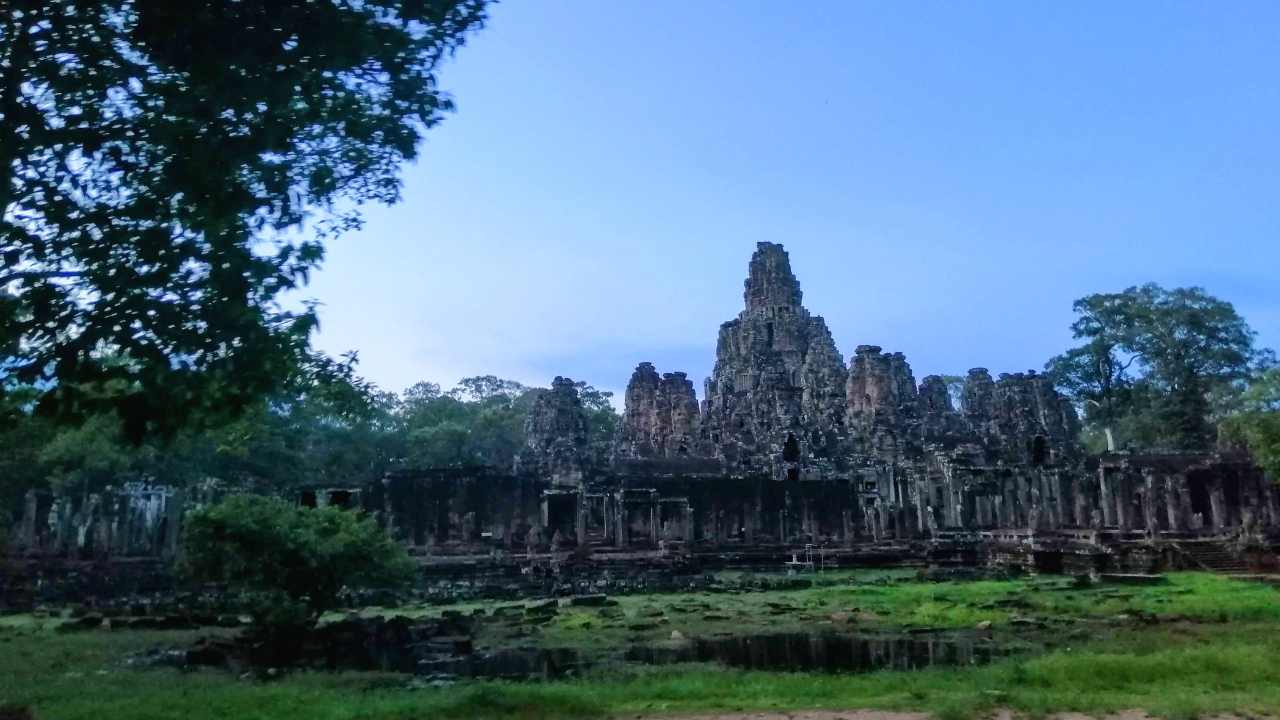
2. Bayon Temple at Angkor Thom – The Smiling Faces
216 Stone Faces Watching Your Every Move
Bayon sits at the center of Angkor Thom, the last great capital city of the Khmer empire. Walk up to this temple and you’ll see massive stone towers. Get closer and those towers resolve into giant faces. 216 of them. All slightly smiling. All watching you.
King Jayavarman VII built Bayon in the late 12th or early 13th century as a state temple representing Mount Meru, the center of the Buddhist universe. Each face reaches up to 2 meters tall. They look out in all four cardinal directions.
Why Bayon Makes the Top 4 Temples for First-Time Visitors to Angkor:
No other temple looks like this. Angkor Wat impresses through scale. Ta Prohm through nature. Bayon through sheer weirdness. Those faces create an atmosphere somewhere between serene and unsettling.
Scholars still debate whose face got carved 216 times. Some say they represent Buddha. Others argue they’re Avalokiteshvara, the bodhisattva of compassion. Still others claim they’re portraits of Jayavarman VII himself. Your guide will probably give you all three theories.
The bas-reliefs here tell stories. The outer gallery shows the Cham-Khmer war, historical battles, and daily life from 800 years ago. You’ll see naval battles on Tonle Sap Lake, market scenes, people gambling, childbirth, illnesses being treated. It’s like a graphic novel carved in stone.
The central section gets confusing fast. Multiple levels, narrow passages, towers connected by galleries, stairs leading to more towers. Bring a sense of direction or follow your guide closely because this place is a maze.
Best time to visit: Mid-morning (9:00-10:30 AM) or late afternoon (3:30-5:00 PM). The faces photograph best with side lighting. Direct overhead sun washes out the features.
What you’ll see:
- 54 towers with 216 massive faces (some towers have four faces, others have three or two)
- Outer gallery bas-reliefs showing the Cham-Khmer war and daily life scenes
- Inner galleries with Buddhist and Hindu imagery mixed together
- Central sanctuary with remaining Buddha statue (head missing)
- Apsara dancers carved in the walls (over 2,000 individual carvings)
- Conservation work by Japanese teams replacing stones
Physical requirements: Moderate. Multiple levels with steep stone stairs. Narrow passages. About 1.5-2 hours to see properly.
Insider tip: Most tourists photograph the faces from ground level where they look impressive but distant. Climb to the upper terraces. You’ll be eye-level with the faces. Much better photos and slightly creepy experience.
| Feature | Details |
|---|---|
| Built | Late 12th-early 13th century under Jayavarman VII |
| Location | Center of Angkor Thom walled city |
| Towers | 54 towers with 216 faces total |
| Faces | 2 meters tall, smiling expression, look in cardinal directions |
| Bas-reliefs | 1,200 meters of carved galleries showing historical events |
| Conservation | Japanese Government Team for Safeguarding Angkor since 1994 |
| Crowds | Very heavy 8:00 AM-4:00 PM |
| Time needed | 1.5-2 hours minimum |
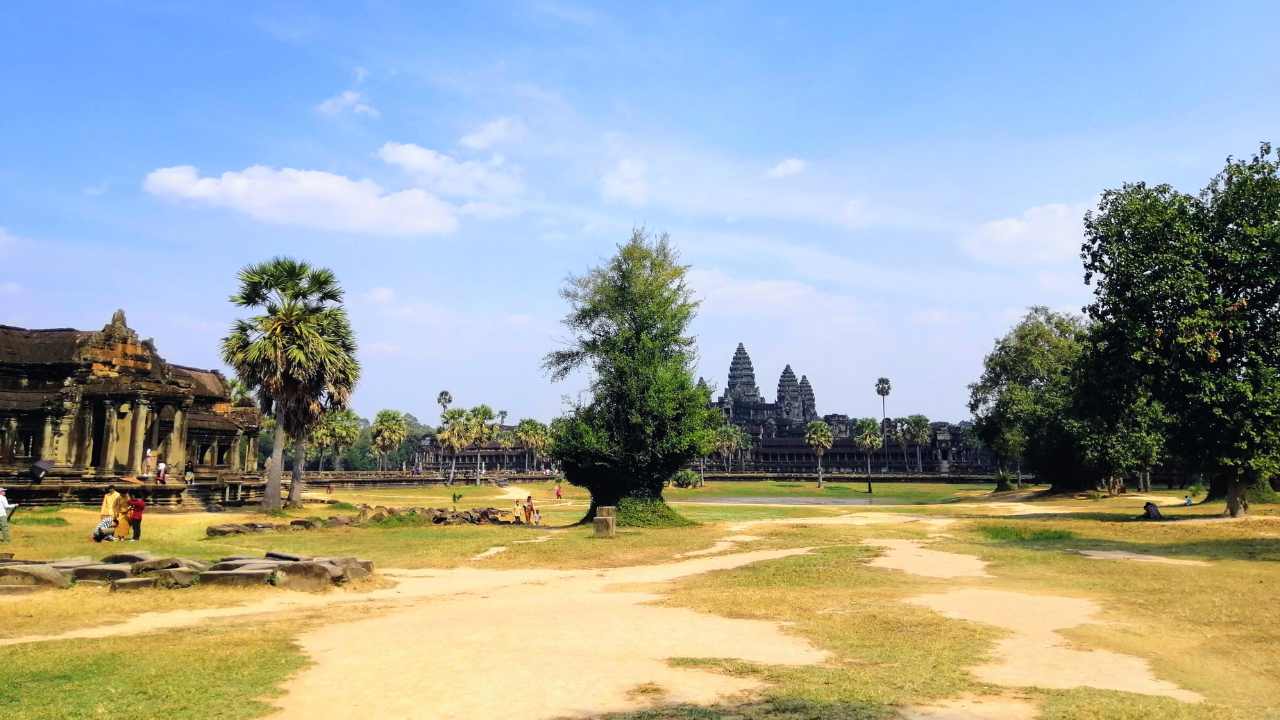
3. Angkor Wat: The One Everyone Knows
World’s Largest Religious Monument (And It Shows)
Angkor Wat appears on Cambodia’s flag. It’s the reason most people come to Siem Reap. Built in the early 12th century by King Suryavarman II, it’s the largest religious structure ever constructed. The temple complex covers 162 hectares. The central tower reaches 65 meters high. The outer moat spans 200 meters wide.
Why Angkor Wat Makes the Top 4 Temples for First-Time Visitors to Angkor:
Because skipping Angkor Wat is like going to Paris and avoiding the Eiffel Tower. Sure, you could make some contrarian argument about authenticity, but you’d regret it later.
The scale alone stuns you. The outer wall runs 3.6 kilometers around the entire complex. The bas-relief galleries stretch 800 meters. Walk the whole thing and you’ll cover several kilometers inside one temple.
But Angkor Wat isn’t just big. It’s precisely engineered. The temple represents Mount Meru, home of Hindu gods. The five towers symbolize Meru’s five peaks. The moat represents the cosmic ocean. The layout aligns with solar and lunar cycles. On spring equinox, the sun rises directly over the central tower.
The bas-reliefs tell the entire Hindu mythology. The south gallery shows the Battle of Kurukshetra from the Mahabharata epic. The east gallery depicts the Churning of the Ocean of Milk (gods and demons pulling a giant serpent to create the elixir of immortality). The west gallery shows the Battle of Lanka from the Ramayana. You could spend days just reading these stone comic books.
Sunrise vs. Sunset debate: Most tours drag you here at 4:00 AM for sunrise. You’ll stand with 2,000 other people in the dark, fighting for photo positions, watching the sun maybe rise (if clouds cooperate). Then you’ll spend the next two hours in harsh morning light feeling exhausted.
Sunset visits work better. Arrive around 4:00 PM. You’re rested. The light is soft. Crowds are smaller. The west-facing temple facade catches golden light beautifully. You can climb all three levels without rushing.
What you’ll see:
- Outer causeway across the moat (350 meters long)
- Main western entrance gopura (gateway tower)
- First level gallery with 800 meters of bas-relief carvings
- Second level with connecting galleries and libraries
- Third level central towers (steep stairs, worth the climb)
- Apsara dancers carved everywhere (over 1,800 representations)
- Reflecting pools (best for sunrise photos if you insist on waking at 3:30 AM)
Physical requirements: High. The third level stairs are extremely steep (about 70-degree angle). Rope handrails help, but if you have knee problems or fear of heights, skip the central tower. The first two levels are manageable for most people.
Insider tip: Most people enter from the west (main entrance). Exit through the east gate instead. You’ll see galleries most tourists skip and avoid the crowds heading back to the main exit.
| Feature | Details |
|---|---|
| Built | Early 12th century (1113-1150) under Suryavarman II |
| Area | 162 hectares total complex |
| Central tower | 65 meters tall (213 feet) |
| Moat | 200 meters wide, 5.5 kilometers around |
| Bas-reliefs | 800 meters of galleries with carved narratives |
| Stone blocks | 5-10 million blocks weighing up to 1.5 tons each |
| UNESCO status | World Heritage Site since 1992 |
| Crowds | Extreme 5:00-8:00 AM (sunrise), Heavy all day, Moderate 4:00-6:00 PM |
| Time needed | 3-4 hours minimum to see properly |
4. Beng Mealea: The Adventure Temple
Where Indiana Jones Would Actually Go
Beng Mealea sits 54 kilometers from Siem Reap, about 1.5 hours by car through rural countryside. Most tourists skip it because of the distance. That’s exactly why it makes the Top 4 Temples for First-Time Visitors to Angkor.
Built in the early 12th century (probably during Suryavarman II’s reign, same king who built Angkor Wat), Beng Mealea uses similar layout and scale. But where Angkor Wat got carefully restored and maintained, Beng Mealea stayed buried in jungle until the 1990s. Even now, restoration focuses on making it safe to visit rather than rebuilding everything.
Why Beng Mealea Makes the Top 4 Temples for First-Time Visitors to Angkor:
Because after seeing the polished, preserved temples at Angkor Park, you need to experience what archaeology actually looks like. Beng Mealea delivers that “discovery” feeling.
Wooden walkways wind over and through collapsed galleries. You’ll climb over stones, duck through doorways, scramble around fallen towers. Trees burst through every structure. Roots flow like water down walls. Entire sections lie in artistic ruins that probably looked similar when French archaeologists first cleared paths through here.
The temple layout matches Angkor Wat’s cruciform design with three enclosing galleries. But collapsed towers create cave-like spaces. You can explore sections most tourists never see because they follow the main walkway only.
The $10 entrance fee (separate from Angkor Pass) goes toward conservation work. UNESCO and Cambodian teams work to stabilize structures without destroying the atmospheric decay. It’s a delicate balance – keeping it safe enough for visitors while maintaining that “lost temple” feeling.
What makes Beng Mealea different from Ta Prohm: Ta Prohm shows controlled preservation with specific trees protected and structures stabilized. Beng Mealea feels wilder. More collapsed. More adventure. Less “museum” and more “active dig site.”
Best time to visit: Morning (9:00-11:00 AM) gives comfortable temperature before midday heat. The remote location means crowds stay manageable even during peak tourist season.
What you’ll see:
- Massive tree roots bigger than anything at Ta Prohm
- Collapsed central sanctuary creating cavernous spaces
- Wooden walkways winding through ruins (making exploration possible)
- Original carvings still visible on some walls
- Working conservation areas
- Almost no crowds compared to main Angkor temples
- Local kids selling cold drinks and snacks at entrance
Physical requirements: High. You’ll scramble over stones, use handrails on walkways, climb through tight spaces. Not suitable for people with mobility issues or young children. Takes 2-3 hours to see properly.
Insider tip: The main wooden walkway covers about 30% of the temple. After following it, ask your guide to show you the sections beyond the walkways. You’ll climb over more stones but see galleries almost nobody photographs.
The Koh Ker and Beng Mealea Jungle Explorer tour combines Beng Mealea with Koh Ker (another remote temple complex 120km away with a pyramid temple). If you’re into adventure archaeology, this full-day tour beats seeing more cleaned-up temples in the main Angkor area.
| Feature | Details |
|---|---|
| Built | Early 12th century, probably under Suryavarman II |
| Distance | 54km from Siem Reap (1.5 hour drive) |
| Entrance fee | $10 per person (not covered by Angkor Pass) |
| Layout | Similar to Angkor Wat but largely collapsed |
| Restoration | Minimal, focuses on stabilization only |
| Trees | Massive strangler figs and silk-cotton trees throughout |
| Walkways | Wooden platforms built in 2001 for safe exploration |
| Crowds | Light to moderate (remote location deters many tourists) |
| Time needed | 2-3 hours minimum |
How to See All Four: The Smart Way
Top Temples for First-Time Visitors with Siem Reap 3 Day Slow Travel
Most multi-temple tours cram everything into exhausting marathon days. You’ll wake at 3:30 AM, visit 8-10 temples, and collapse by afternoon. The next day you do it again. By day three, temples blur together and you’re counting hours until you can sleep on the plane home.
The Siem Reap 3 Day Slow Travel approach visits all four temples at optimal times with built-in rest periods:
Day 1 Schedule:
- 5:40 AM hotel pickup (civilized timing, not brutal)
- 6:00-8:00 AM Ta Prohm (before crowds, perfect light)
- 8:45-10:15 AM Bayon and other Angkor Thom sites
- 11:00 AM-3:45 PM hotel rest break (pool, lunch, nap during peak heat)
- 4:00-6:00 PM Angkor Wat at golden hour
- Evening Apsara dance show
Day 3 Schedule:
- 9:30 AM hotel pickup (flexible based on your flight)
- 10:50 AM-1:00 PM Beng Mealea jungle temple
- Direct transfer to airport
This timing hits each temple when light and crowds work in your favor. The midday break on Day 1 isn’t laziness – it’s smart travel design. You’ll be rested for afternoon Angkor Wat instead of zombie-tired.
What this approach gets you:
- ✅ All four temples seen properly, not rushed
- ✅ Golden hour photography at Ta Prohm and Angkor Wat
- ✅ Rest during midday heat (35-38°C / 95-100°F)
- ✅ Smaller crowds through strategic timing
- ✅ Energy to actually remember what you’re seeing
- ✅ Floating village and countryside experiences included
- ✅ No 3:30 AM wake-ups destroying your vacation
Siem Reap 3 Day Slow Travel – Experience Cambodia’s Ancient Wonders Without the Rush
Quick Comparison Table: Which Temple Offers What
| Temple | Crowd Level | Physical Difficulty | Best Photo Time | Unique Feature | Time Needed |
|---|---|---|---|---|---|
| Ta Prohm | Heavy after 8:30 AM | Easy-Moderate | 6:00-8:00 AM | Tree roots through galleries | 1.5-2 hours |
| Bayon | Very Heavy all day | Moderate | 9:00 AM or 4:00 PM | 216 smiling stone faces | 1.5-2 hours |
| Angkor Wat | Extreme at sunrise | Moderate-High | 4:00-6:00 PM | World’s largest religious structure | 3-4 hours |
| Beng Mealea | Light-Moderate | High | 9:00-11:00 AM | Unrestored jungle adventure | 2-3 hours |
My Take on These Four Temples
I’ve visited Angkor five times over 12 years. Each trip I see tourists making the same mistakes: trying to see everything, waking up absurdly early, pushing through midday heat, treating temples like photo backdrops instead of places with stories.
The Top 4 Temples for First-Time Visitors to Angkor work because they’re genuinely different from each other. Ta Prohm’s trees, Bayon’s faces, Angkor Wat’s scale, Beng Mealea’s adventure – you won’t confuse them later when looking at photos.
Skip temples 5-40. You won’t miss them. You’ll just have energy left to actually enjoy the four that matter.
Want to see these four properly? Start by checking available dates at Journey Cambodia. Book tours that prioritize timing over volume. Rest during peak heat. And for the love of ancient Khmer architecture, skip the 4 AM sunrise tours.
Additional Resources
- Angkor Archaeological Park Official Website – Current entrance fees, rules, and conservation information
- Siem Reap 3 Day Slow Travel Tour – Visit all four temples with optimal timing and rest breaks
- Koh Ker and Beng Mealea Jungle Explorer – Extended adventure tour combining multiple remote temple sites