 Skip to content
Best Siem Reap Sunset View Points
Where You Actually Get Space to Breathe (And Photos Without 300 Strangers Photobombing)
Siem Reap sunset view points deliver their best show outside the temple circuit. The smartest travelers skip Phnom Bakheng’s 300-person platform stampede and head straight to Baitang’s rice paddies (accessible via countryside tours departing 3:00-4:30 PM), rooftop bars overlooking Angkor Wat with cold cocktails, or the Royal Gardens where 10,000 bats create a swirling dusk spectacle.
Sunset hits between 5:35 PM (November) and 6:35 PM (June-July), giving you about 45 minutes of usable golden hour light.
The secret? These Siem Reap sunset view points pair stunning photography conditions with real experiences – whether you’re holding a Cambodian beer in emerald paddies, watching farmers walk home past water buffalo, or sitting in a traditional wooden house after sunset enjoying dishes cooked by village women using their grandmother’s recipes. Tours cost $48-65 and include transport, sunset drinks, snacks, and zero crowds.
Your Fast-Track Guide to Siem Reap Sunset View Points
Siem Reap sunset view points. You’ve typed it into Google already, haven’t you? And every single result probably told you the same thing: climb Phnom Bakheng temple, squeeze onto that platform with 300 sweating tourists, fight for a decent camera angle, get someone’s selfie stick in your peripheral vision.
There’s got to be a better way, you’re thinking.
There is. Seven better ways, actually – and I’ve spent enough golden hours chasing light around this city to know which Siem Reap sunset view points deliver that perfect combination of stunning views and actual elbow room. Because here’s what they don’t tell you in the guidebooks: some of the most jaw-dropping sunsets happen in places where you can spread out, set up your tripod without knocking into someone, maybe even have a cold drink in your hand while the sky goes through its nightly color transformation.
The Phnom Bakheng Problem (And Why You Should Skip It)
Let me paint you a picture of what typically happens. You read one (outdated) guidebook entry about Phnom Bakheng being “the” sunset temple. You show up around 4:30 PM feeling pretty good about your planning. Then you see the line. A slow-moving river of humanity, all funneling toward the same steep stone staircase. You join it because… well, everyone else is doing it, right?
Forty minutes later, you’ve finally reached the top. Every decent viewing spot is claimed – people sitting cross-legged on stones, tripods marking territory, couples doing their pre-sunset selfie routine. You wedge yourself into a gap between someone’s massive backpack and a tour group. The sun sets. You got maybe two mediocre shots. This was supposed to be magical?
The issue isn’t Cambodia’s golden hour (which is consistently gorgeous February through December). The problem is that 95% of travelers chase the same overcrowded Siem Reap sunset view points while better options sit practically empty just 10 kilometers away. Places where the light hits just as beautifully, where you can move around freely, where maybe you’re sipping something cold instead of sweating into your camera lens.
So forget Phnom Bakheng. There are better ways to watch the sun drop over Cambodia.
Understanding Siem Reap’s Golden Hour Window (Month by Month)
Before we get into specific locations, you need to understand the timing. Cambodia sits at 13°24′ N latitude (pretty close to the equator), which means sunset times stay fairly consistent year-round – only about a 60-minute swing between earliest and latest.
November brings the earliest sunsets: around 5:35 PM
June and July deliver the latest: roughly 6:30-6:35 PM
Everything else falls somewhere between: 5:45-6:20 PM
But here’s what matters more than the exact sunset moment – golden hour starts 45 minutes before the sun actually touches the horizon. That’s when the light turns soft and amber, when everything glows. If you show up just 10 minutes before sunset, you’ve already missed the best photography window.
My rule? Arrive at your chosen spot by 5:00 PM regardless of season. You’ll catch the full golden hour progression, from that first warm shift in light quality through to the deep orange-pink finale as the sun disappears.
The 7 Best Siem Reap Sunset View Points (Ranked by Experience, Not Just Views)
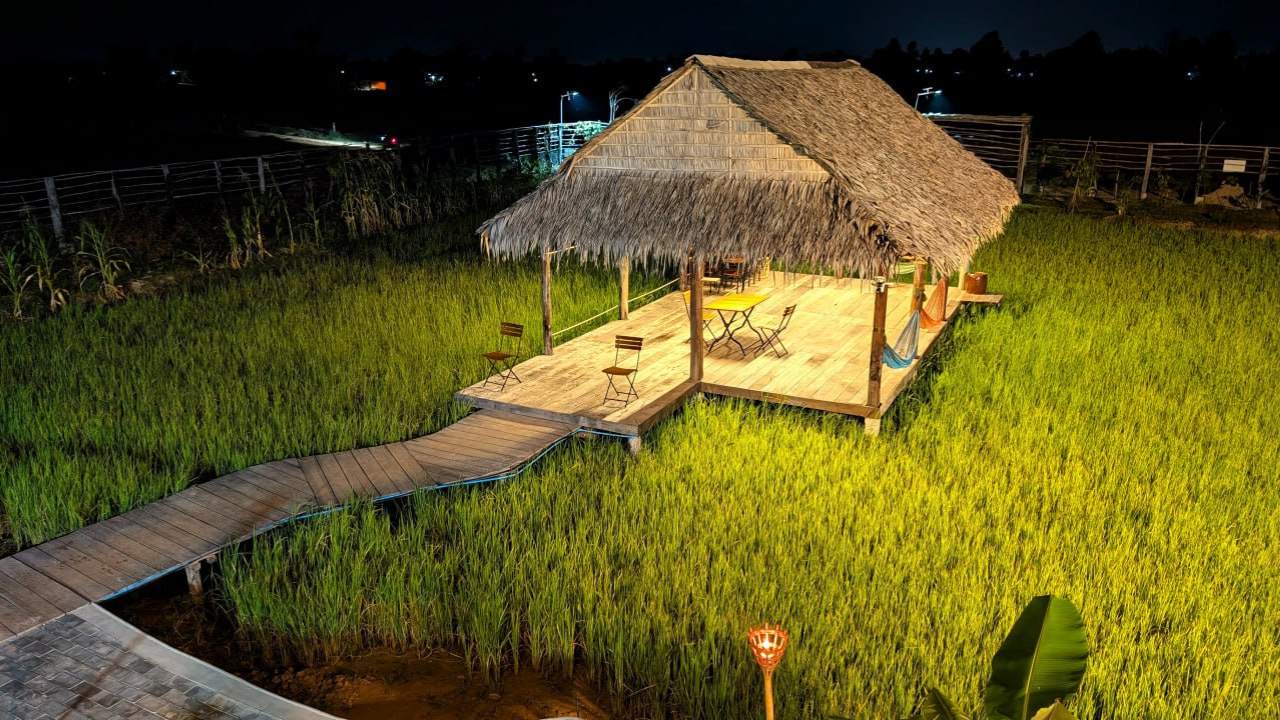
1. Baitang Siem Reap Rice Fields – Where Locals Go When They Want to Remember Why They Love Cambodia
I’m going to be straight with you: this is the spot. If you only have one sunset evening in Siem Reap and you want the experience that’ll stick with you long after you’ve forgotten which temple was which, Baitang’s rice paddies are where you go.
Located roughly 15-20 minutes outside the city center (depending on traffic and how fast your tuk-tuk driver takes corners), these working rice fields offer something the temple platforms simply can’t match – that 360-degree panorama of countryside life at its most photogenic moment. Emerald paddies stretching to the horizon. Wooden houses on stilts. Water buffalo cooling off in ponds. Farmers walking home along dusty paths with their tools over their shoulders. And the light… the light does things to this scene that makes your camera work overtime.
What makes Baitang different from every other “countryside sunset” spot:
You’re not observing from a distance – you’re sitting IN the rice fields. Not on a platform above them, not viewing them through restaurant windows. You’re there, at ground level, surrounded by the same landscape those farmers see every evening. When the breeze picks up and moves through the rice stalks, you hear it. When egrets fly overhead heading to their roosting spots, they pass right over you. This isn’t scenic viewing; it’s full immersion.
The light changes every 3-4 minutes during peak golden hour. First everything’s bright green-gold, almost citrus-colored. Then it shifts to amber, deeper and warmer. Then that incredible deep orange phase where the whole world looks like it’s lit from within. Finally – and this is the phase most people miss because they leave too early – the blue hour, when the sky goes purple-indigo and the rice fields turn silvery.
Timing your Baitang sunset:
Arrive by 4:30-5:00 PM. You want time to walk around a bit, try different angles, let your eyes adjust to the space. Many tours include cold drinks (beer or soft drinks) and local snacks (sometimes seasonal fruits, occasionally crispy fried insects if you’re feeling adventurous… you don’t have to eat them, but they’re there).
Getting there:
Most countryside tours position Baitang as their sunset finale because the timing works perfectly. The Siem Reap Rice Field Sunset Tour with Home Cooked Dinner might be my favorite version of this experience. They plant you directly in the paddies at 4:30 PM with drinks in hand, let you soak in that golden hour magic, then – after the sun drops – you walk through quiet village paths to a traditional wooden Khmer house where local women cook you dinner using their grandmother’s recipes. Real family dishes, not tourist-menu versions. Two hours total, costs about $55-65, and nearly everyone I’ve sent there calls it their best evening in Cambodia.
Insider tip for photographers:
The growing season (May-October) gives you that electric-green rice color that photographs beautifully against blue sky. Harvest time (November-December) turns everything golden-brown, which creates this monochromatic warm palette. Both are gorgeous; just different aesthetics.
2. Phnom Krom Temple – The Alternative Temple View (For People Who Still Want Elevation)
Okay, so maybe you really do want that elevated temple perspective – you just don’t want the Phnom Bakheng circus. Fair enough. Phnom Krom delivers temple ruins, panoramic views, and actual breathing room, though you’ll pay for it with a steeper climb.
This hilltop temple sits about 12 kilometers south of Siem Reap, overlooking Tonle Sap Lake. The views are completely different from rice-field sunsets or jungle-temple backdrops. You’re looking out over Cambodia’s massive inland sea (it quadruples in size during rainy season), flooded forests, fishing villages on stilts, and water that reflects whatever color show the sky’s putting on that evening.
Why fewer people come here:
The climb is steeper and longer than Phnom Bakheng. The temple itself isn’t as famous or well-preserved. It’s farther from the main temple circuit. All of which means you might share the summit with 10-15 people instead of 300. For sunset photographers, this is worth every bit of extra effort.
Practical details:
Hire a tuk-tuk for about $15-20 round trip (negotiate the price before you leave, and make sure they understand they’re waiting to bring you back after sunset). Leave your hotel by 4:15 PM to allow time for the drive and climb. Bring water – this climb is no joke in the heat.
Fair warning:
If you’re not reasonably fit, if you have knee problems, or if heat bothers you… maybe skip this one. The stairs are steep, irregular, and there’s limited shade. But if you can handle it, the payoff is big.
3. Rooftop Bars with Angkor Views – Sunset with Air Conditioning Breaks
Sometimes you don’t want to climb temples or trek through rice fields. Sometimes you want a proper chair, a cold cocktail, maybe some bar snacks, and a bathroom that flushes. I get it. There’s no shame in comfort.
Several spots around Siem Reap offer rooftop terraces with sight lines to Angkor Wat (on clear days) or general views over the city and surrounding countryside. FCC Angkor is probably the most well-known. Various boutique hotels have followed suit with their own rooftop bars and restaurants.
What you get:
- Actual seating (chairs! tables! cushions!)
- Full bar and food menu
- Bathrooms on-site
- Usually some level of air conditioning or at least fans
- Angkor Wat silhouette visible on clear days (about 60-70% of the time)
- Zero climbing, zero dust, zero fighting for space
What you trade for that comfort:
You’re farther from the action. The views are more distant, less immersive. It feels more like watching a show than being part of the scene. And you’ll pay drink prices to match the view ($5-12 per cocktail typically).
My take? This works great as a secondary sunset experience if you’re in Siem Reap for several days. Watch one sunset in the rice fields, another from a temple, a third from a rooftop bar with a proper gin and tonic. Mix it up.
Timing: Arrive by 5:00-5:30 PM to claim a good table before the prime viewing window.
4. Royal Gardens and the Bat Emergence – Nature’s Weirdest (Best) Sunset Sideshow
This one’s completely different. You’re not primarily watching the sunset itself – you’re watching what happens AS the sun sets. Around twilight each evening, thousands upon thousands of fruit bats emerge from their roosting trees in the Royal Gardens, creating this swirling, almost surreal black cloud against the colorful sky. They spiral upward in massive groups, then scatter across the city to their feeding grounds.
It sounds like something from a nature documentary. But you’re standing there, neck craned upward, watching it happen 20 meters above your head while the sky behind them goes orange, pink, purple. The nearby Preah Ang Chek Preah Ang Chorm Shrine (an important spiritual site for Cambodians) adds cultural weight to what could otherwise feel like pure spectacle.
What makes this worth your time:
- Completely free to visit
- Right in the city center (easy walking access)
- The bat emergence is genuinely spectacular
- Combines natural phenomenon with cultural site
- Works great as part of a multi-stop afternoon
Best arrival time: 5:30-6:00 PM (the bats typically start their exit around sunset)
How to experience this properly:
The Sightseeing Siem Reap tour actually packages this beautifully. You start at 1:00-1:30 PM (depending on season) with a visit to APOPO’s Visitor Center where you meet landmine-detecting HeroRATs (seriously – trained rats that save lives by finding unexploded ordnance; it’s remarkable). Then you hit Buddhist monasteries, the Royal Gardens for the bat show, and finish with sunset drinks in the countryside. At $48 per person with private guide and transport included, it’s one of the best value ways to experience multiple Siem Reap sunset view points in a single afternoon.
5. Siem Reap River Walkway – The Unglamorous Local Favorite
Not every great sunset requires production value. Sometimes the best ones happen when you’re just… walking along a river, watching the sky reflected in the water, with local life unfolding around you exactly as it would whether you were there or not.
The Siem Reap River runs through the city with walkways along both banks in certain sections (particularly near Pub Street and the Old Market area). In late afternoon, this becomes a gathering spot for Cambodian families taking evening strolls, vendors setting up snack carts, occasional fishermen trying their luck, students walking home from school.
What you get here:
Zero infrastructure (which means zero tourist commercialization). Beautiful sky reflections in the water. Flat, easy walking – accessible for any fitness level. Street food vendors nearby if you want to grab some grilled corn, fresh fruit, or num pang sandwiches.
What you don’t get:
Epic panoramic views or dramatic elevation. This isn’t about spectacle. It’s about simplicity and local authenticity.
My recommendation? This works best as an unstructured sunset option. If your other plans fall through, if you’re staying near the river anyway, if you just want a low-key evening – head to the walkway around 5:15 PM, grab a snack from a vendor, post up on a bench, watch the sky do its thing.
6. West Baray – The 1,000-Year-Old Reservoir That Most Tourists Never See
West Baray is massive – 8 kilometers long by 2.2 kilometers wide. This ancient reservoir dates back to the 11th century Angkorian period, built to supply water for rice cultivation and serve as a religious symbol. Today it still functions as a reservoir, but it also offers something increasingly rare in tourist-heavy Siem Reap: empty shoreline at sunset.
The water creates perfect mirror reflections of the sky. The sheer scale makes you feel appropriately small. And because most visitors stick to the main temple circuit, you might have entire sections of shoreline to yourself.
What makes West Baray special:
- Historical significance (this thing is over 1,000 years old)
- Huge open water = dramatic reflections
- Almost zero tourists at sunset
- Swimming possible if you’re brave (locals do it)
- Different vantage points along 8 kilometers of shoreline
Getting there:
It’s about 8 kilometers west of Angkor Wat. Negotiate a tuk-tuk for roughly $10-15 round trip. Arrive by 5:00 PM.
Critical note: Bring mosquito repellent. You’re near water, at dusk, in a tropical climate. The bugs WILL find you. Also bring water to drink – there’s minimal infrastructure out here.
7. Countryside Villages via Bicycle or Tuk-Tuk – Sunset Where Real Life Happens
Sometimes the best Siem Reap sunset view points aren’t actually fixed locations at all. They’re those spontaneous moments that happen when you’re exploring village life and golden hour just… arrives. That wooden bridge over an irrigation channel where farmers cross on their way home. That spot between rice paddies where three paths converge. That family’s front yard where they’re cooking dinner outside as the light turns amber.
These moments don’t appear on any map. They’re different every time. But once you leave the city center and start wandering through villages, they’re everywhere.
What this experience delivers:
- Genuine village atmosphere
- Chance encounters (kids playing, families cooking, farmers finishing their day)
- Photography that feels like discovery rather than checking boxes
- Stories you’ll actually remember (“this farmer showed us his rare white crocodiles…”)
The timing challenge:
You need to build in exploration time before sunset, which means starting your countryside tour around 3:00-4:00 PM. This gives you space to visit farms, markets, village sites, THEN position yourself for golden hour without rushing.
The smart way to do this:
The Siem Reap Countryside Tour basically builds this entire concept into a structured (but flexible) 3.5-hour experience. You choose your transport method – bicycle, e-bike, or tuk-tuk – then your private guide takes you through vegetable farms, local markets, fish farms, even a family that raises crocodiles (including rare white ones). Starting at 3:00 PM, you finish with sunset at a perfect countryside location with cold drinks and snacks. You’re back by 7:00 PM with a camera full of photos and actual stories to tell.
What to Pack for Any Siem Reap Sunset View Point
Let me save you from the mistakes I’ve watched people make repeatedly:
Bring these things:
- Camera or smartphone (obvious)
- EXTRA BATTERY or power bank (golden hour photography kills batteries fast)
- Sunglasses (late afternoon sun is still bright pre-sunset)
- Hat or cap (for that pre-golden-hour period when it’s still hot)
- Mosquito repellent (especially for rice fields, rivers, or water areas)
- Light jacket or shawl (November-February evenings get cooler than you expect)
- Small amount of cash ($5-20 USD for tuk-tuk tips, snacks, drinks)
- Water bottle (you’ll want it for the ride back)
Don’t bring these things:
Large backpacks (too cumbersome), expensive jewelry (why risk it), anything you’d stress about while trying to enjoy the moment.
Photography tip: If you’re serious about sunset shots, bring a small lens cloth. Dust is everywhere in Cambodia, and a smudged lens ruins photos faster than bad light.
The Sunset Experience That Changes How You See Cambodia
Look – Angkor Wat is magnificent. The temples deserve their UNESCO status and their spot in every guidebook. You should absolutely see them. But if your entire Cambodia experience consists of stone ruins, air-conditioned hotels, and Pub Street, you’re missing the thing that makes this place actually memorable.
The countryside at golden hour, when the light turns everything soft and amber, when farmers walk home with their tools balanced across their shoulders, when the rice fields glow like they’re lit from beneath the surface, when village kids wave at passing foreigners and someone’s grandmother smiles at you from her porch… that’s when Cambodia stops being a destination and starts being a place.
The Siem Reap sunset view points in this guide range from dead simple (river walkway) to moderately adventurous (cycling through villages). Some cost nothing. Others work best as part of a tour package. But they all share one thing: space to actually experience the moment without feeling sardined between 300 other tourists doing identical Instagram poses.
So maybe skip the Phnom Bakheng stampede this time. Head out to Baitang’s rice paddies with a cold beer in hand. Watch those 10,000 bats swirl out of the Royal Gardens. Find a quiet bridge between paddies and just… pause for 20 minutes. The temples have stood for 900 years. They’ll be there tomorrow. They’ll be there next week.
But this particular sunset, with this particular light, with this exact configuration of clouds and color? That only happens once.
Tours That Nail the Sunset Experience:
Siem Reap Rice Field Sunset Tour with Home Cooked Dinner – Drinks in working rice paddies starting 4:30 PM, followed by home-cooked Khmer meal in traditional wooden house (2-2.5 hours, private or small group)
Sightseeing Siem Reap – Private afternoon combining HeroRATs, Buddhist monasteries, Royal Gardens bat emergence, and countryside sunset with drinks ($48 per person, 4.5-5 hours)
Siem Reap Countryside Tour – Private tour via bicycle, e-bike, or tuk-tuk through villages, farms, and markets ending with sunset over rice fields (3-3.5 hours starting 3:00 PM)